


Your shopping cart is empty!
Cauliflower "Marzatico"

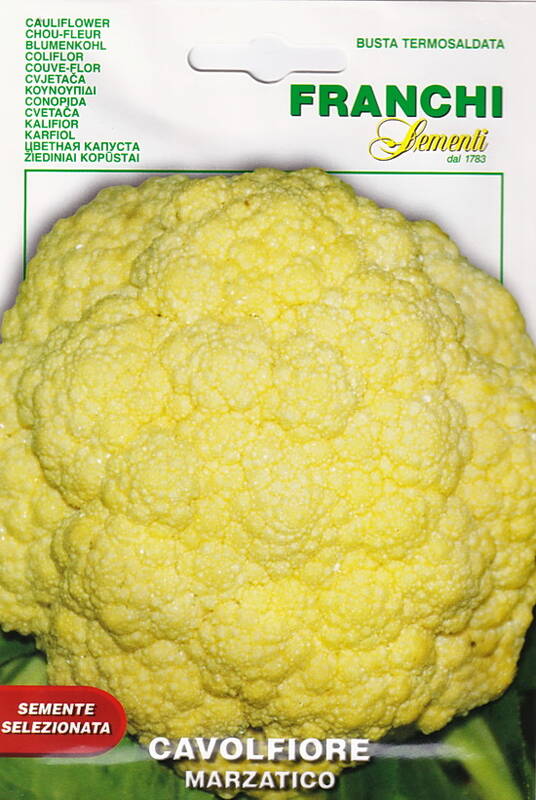
Brassica oleracea var. botrytis L.
1,55€
Ex Tax: 1,25€
Ex Tax: 1,25€
Cauliflower "Marzatico" - Brassica oleracea var. botrytis.
Creamy, dense, and vitamin-rich!
A late-ripening, high-yielding variety that will delight you with a quality summer harvest. Forms classic, very dense heads of an attractive creamy-white colour.
Variety value:
1. Taste and Health: Possesses excellent taste qualities. It is a superb dietary product with tender fiber, easily digested by the body and rich in vitamins.
2. Uniform harvest: The heads ripen almost simultaneously, which is convenient for mass harvesting and processing.
3. Usage: Ideal for freezing, canning, cream soups, and side dishes.
Agrotechnics:
Seeds are sown to a depth of 0.5 cm. Cauliflower loves fertile, moisture-retentive soils.
Sowing: March.
Planting out seedlings: May.
Spacing: 40x40 cm.
Harvesting: July – August.
Important: The optimal temperature for the formation of large and dense heads is +15+18°C (in extreme heat, the heads may become loose, so watering is crucial).
Creamy, dense, and vitamin-rich!
A late-ripening, high-yielding variety that will delight you with a quality summer harvest. Forms classic, very dense heads of an attractive creamy-white colour.
Variety value:
1. Taste and Health: Possesses excellent taste qualities. It is a superb dietary product with tender fiber, easily digested by the body and rich in vitamins.
2. Uniform harvest: The heads ripen almost simultaneously, which is convenient for mass harvesting and processing.
3. Usage: Ideal for freezing, canning, cream soups, and side dishes.
Agrotechnics:
Seeds are sown to a depth of 0.5 cm. Cauliflower loves fertile, moisture-retentive soils.
Sowing: March.
Planting out seedlings: May.
Spacing: 40x40 cm.
Harvesting: July – August.
Important: The optimal temperature for the formation of large and dense heads is +15+18°C (in extreme heat, the heads may become loose, so watering is crucial).
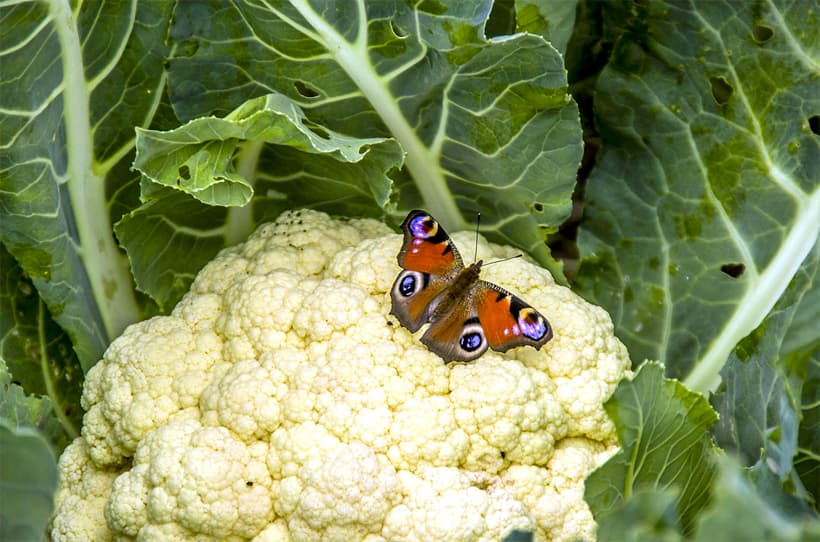
* Important nuances of growing cauliflower.
At high temperatures (about +30°C), the head either grows into a loose, broom-like shape or does not form at all. Moreover, on a hot summer day at such high temperatures, a well-developed plant evaporates a lot of water. Even a break in watering for a few days prevents the head from setting.
Finally, the cause of serious failures can be the wrong choice of varieties and incorrect sowing dates.
The fact is that when choosing seeds and determining the sowing date, we often do not think about when we will harvest. And this is the most important question, because it determines which varieties (early or late) need to be purchased.
A mistake in variety selection leads to plants entering the head formation stage during a period of high temperatures. In this case, some plants will not produce heads at all, while others will only produce loose "brooms".
Strategy for success:
1. Early varieties: Sow March 15-20, plant seedlings in early May, and harvest in mid-June (before the heat sets in). If the temperature rises above +25°C at this time, the heads may start to crack quickly and will have to be harvested almost every day.
2. Mid-season and late varieties: Sow in early June, calculating to harvest in August-September. If the nights in September are already cold, the development of the head will be slower, but it will turn out much larger and denser than that of early varieties.
Care:
Cauliflower is demanding! To get a large head, the plant must grow at least 20 leaves. The soil must be constantly moist. Even a 4-day break in watering during the setting period leads to the head being small and crumbly.
In hot weather, in addition to watering, plants should be sprayed with water to lower the temperature. Shading is desirable during hot hours, otherwise, the heads may darken or turn purple.
Protecting the whiteness of the head:
The simplest, but not the best way is breaking a leaf over the head. It is much better not to break the leaves, but to tie 2-3 leaves over the head with twine like a "tent". You can also cover the heads with paper or burdock leaves.
Harvesting:
Heads do not ripen simultaneously, harvest them selectively. Leave 3-4 outer leaves for protection. Do not squeeze or stack the heads on top of each other tightly — brown spots may appear in a few days.